




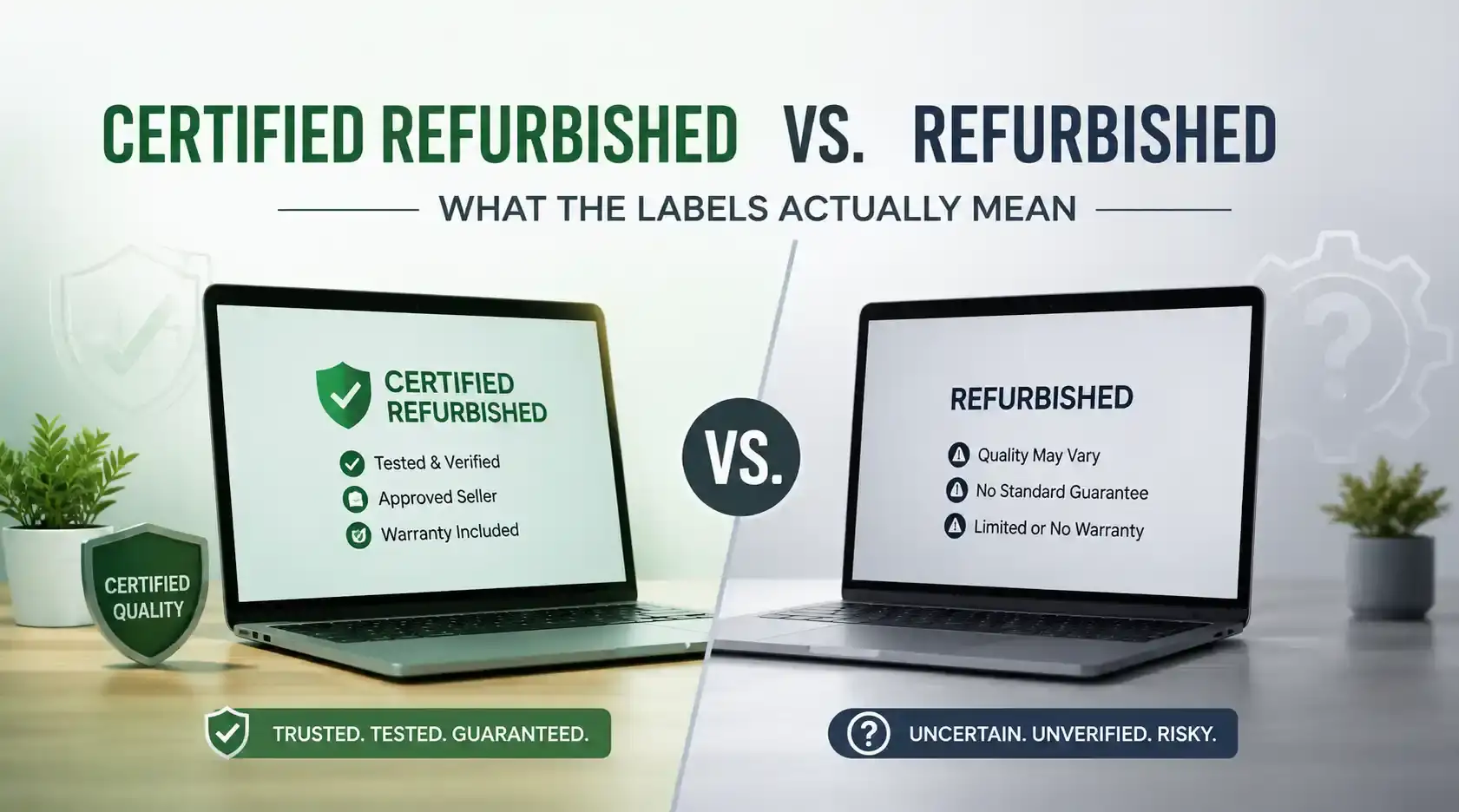
The label on a refurbished product listing doesn't tell you much on its own. Two laptops can both say "refurbished" and arrive in completely different conditions. One went through a full diagnostic, had a worn battery replaced, and came with a 12-month warranty. The other got wiped, passed a basic power-on test, and shipped out. The wording on the box was identical.
This article covers what these labels actually mean, who can issue them, and when the price difference between certified and standard refurbished is worth paying.
Refurbished means the product was used or returned and restored to working condition. That is the only thing the label guarantees on its own.
There is no universal standard for how thorough that restoration process has to be. Some sellers run full component diagnostics, replace degraded parts, and grade units by cosmetic condition before listing them. Others do a factory reset, confirm the device powers on, and call it done. Both are allowed to use the word "refurbished."
This is not a fringe problem. It is the normal state of the refurbished market. The label alone does not tell you which process you are buying.
What matters is the seller behind the listing: their testing checklist, their return policy, and whether they publish either publicly. A seller who is vague about what "refurbished" means in their workflow is a seller worth approaching carefully.
Certified refurbished means the product has a documented process behind it. Instead of relying on a seller's discretion, the product has gone through a defined set of tests and met a stated standard before it was listed.
A legitimate certified refurbished program will typically cover battery health (usually tested to a minimum percentage of original capacity), screen condition, port function, and cosmetic grading. It will also come with a warranty, typically between 90 days and one year, and in many cases include manufacturer-equivalent accessories.
The word "certified" does not guarantee quality on its own either. The value of the certification depends entirely on who issued it and what their process actually involves. A certification badge from a credible manufacturer or a well-documented third party is meaningful. The same badge from an unknown reseller with no published checklist is not.
Yes, the issuer matters a great deal.
Programs like HP Renew, Dell Certified Refurbished, and Lenovo Certified Refurbished run devices through diagnostics designed by the same brand that built the hardware. These programs test to factory specifications, use original or OEM-equivalent replacement parts, and typically offer a one-year warranty that is close to what you would get on a new unit.
The reliability of these programs comes from accountability. HP, Dell, and Lenovo have reputations tied directly to what goes out under their names. They have the service infrastructure and parts supply to back it up.
Third-party certifiers are independent of the original manufacturer. Some are excellent. Some are not. The difference is almost always in the documentation.
A credible third-party refurbisher publishes their testing checklist. It will specify battery health thresholds, screen-condition standards, what counts as a dead pixel, whether hinges and ports are individually tested, and the cosmetic grading criteria. If that information isn't publicly available, or if the seller will not provide it on request, the certification carries little weight.
Before buying from any third-party certified seller, ask for their written testing criteria and warranty terms. Legitimate refurbishers will not hesitate to share both.
For business-critical devices, certified refurbished is usually the right call.
Laptops used daily for work, servers, or equipment that feeds into compliance requirements need to perform reliably and have a clear support path when something goes wrong. Certified programs give you standardized testing and a warranty with defined coverage. Standard refurbished typically comes with a 30-to 90-day seller warranty, sometimes less.
The price difference between standard and certified refurbished usually runs around 10 to 20 percent, depending on the device. For a device that an employee uses every day, that premium is cheap insurance. Downtime costs more than the warranty.
If you are sourcing in bulk for a business deployment, the consistency that comes with a certified program matters too. Standard refurbished lots are more variable. You may get ten excellent units and two with battery health well below what you expected because the seller had no threshold in their process.
Browse our refurbished laptops if you are comparing options for a business order and want to see what is currently in stock.
For lower-stakes purchases, standard refurbished is often a perfectly good option and a better value.
A secondary device, a kid's tablet, a spare monitor for occasional use, a desktop for a light task like reception or POS work: none of these need a manufacturer-certified process to be a solid buy. The risk profile is lower, and the savings from going standard can be real.
What protects you in this case is not the label but the seller. Check their reviews across multiple platforms, not just their own listing. Confirm the return policy in writing before buying. A 30-day return window from a seller with consistently good feedback is reasonable protection for a low-stakes purchase.
You can browse our full inventory to compare what is available at different price points across categories.
Both labels rely more on the seller's process than on what is printed in the listing.
In most markets, no authority actively verifies that a product labeled "certified refurbished" actually went through a certification process. A seller can legally use the term without any third-party backing, which means the label can be applied loosely.
Before you buy either type, verify three things: who issued the certification (if any), whether a public testing checklist exists, and what the warranty terms say in writing. If a seller cannot answer those questions, that is a reason to look elsewhere.
Ask directly: what parts were replaced, what was the battery health reading at the time of testing, and what happens if the device fails within the warranty period. A seller who has done the work will have answers ready.
Warranty length is one of the clearest practical differences between standard and certified refurbished.
Standard refurbished products often come with a 30-to 90-day seller warranty. Some sellers offer less. Certified refurbished programs, particularly those backed by manufacturers, typically cover 90 days to a full year.
Beyond the length, read what the warranty actually covers. Some warranties replace the full unit if it fails. Others cover only specific components, such as the battery or screen, and leave you responsible for anything outside that list. A 12-month warranty that only covers the display is not the same as a 12-month warranty on the whole device.
Cosmetic grading describes the device's physical condition, not its functional performance. Most refurbishers use a three-tier system: Grade A for minimal or barely visible wear, Grade B for noticeable scratches and scuffs, and Grade C for heavier cosmetic damage that does not affect function.
Certified refurbished listings tend to include the cosmetic grade explicitly, sometimes with photos. Standard refurbished listings often use looser language like "good condition" or "like new" without a defined benchmark.
If you want to understand exactly what those grades mean and how they affect pricing and resale value, our guide to refurbished laptop grades breaks down what A, B, and C actually cover and what to ask your supplier before committing to a bulk order.
Battery condition is one of the more consequential unknowns in a used device. A laptop can look clean and pass every functional check while running on a battery that is already at 55% of its original capacity.
Most certified refurbished programs set a minimum battery health threshold, commonly 80% of original capacity, and replace batteries that fall below it before listing the device. If the program you are buying from does not publish this threshold, ask for it before you order.
Standard refurbished listings often skip battery health disclosure entirely. You may not find out the actual reading until you start using the device and notice it drains faster than it should. For a single personal purchase, that is manageable. For a bulk order of 50 units going to remote employees, it is a real problem.
A legitimate certified refurbished product should come with a test report or inspection certificate. This document shows what was tested, whether all checks passed, and which parts (if any) were replaced.
If a seller cannot provide this documentation for a product they are calling "certified," that is a meaningful red flag. Ask for it before you pay. Certifiers with an actual process will have this ready.
Where a refurbished device came from before it was processed matters.
Corporate lease returns tend to be the most predictable category. These are devices that were used in managed IT environments, often on regular maintenance schedules, and returned at the end of a fixed lease term rather than because something went wrong. The usage history is more consistent, and wear is usually even across units.
Consumer trade-ins are harder to assess. Usage patterns, physical handling, and prior damage vary much more from unit to unit. That does not make trade-in stock unreliable, but it does make supplier transparency more important. If a seller can tell you the sourcing category, that is a detail worth knowing before placing a large order.
Some certified programs specify the sourcing type in their listings, such as "corporate lease return" or "open box." If you are buying in volume, that detail can help you estimate what the stock will look like when it arrives.
Nexvora sources refurbished IT equipment through verified supply channels built on over 20 years of industry experience. You can read more about how we work and what that means for product consistency.
The difference between certified refurbished and standard refurbished comes down to testing transparency and warranty coverage. Certified programs document the process and back it with a warranty. Standard refurbished relies on the seller's own standards, which vary significantly.
For business-critical devices or bulk orders where consistency matters, certified is the safer choice. For lower-stakes purchases with a solid return policy, standard refurbished can be a better value.
Either way, the label is a starting point, not a guarantee. What matters is the process behind it.
If you want to compare options or need a quote for a bulk order, get in touch with our team, and we will confirm grading specs and warranty terms in writing before you commit.
A certified refurbished product has gone through a documented testing process verified by a manufacturer or accredited third party, with a defined warranty attached. Standard refurbished has no universal testing requirement and depends entirely on the individual seller's process.
No. Certified refurbished can be issued by a third-party refurbisher or by the original manufacturer. Check who issued the certification and whether they publish their testing criteria before assuming manufacturer involvement.
For daily-use business devices or equipment where downtime has a real cost, yes. The better warranty and standardized testing reduce risk. For low-stakes personal purchases, standard refurbished from a reputable seller with a clear return policy is often sufficient.
Most certified programs offer between 90 days and one year. Manufacturer-certified programs tend toward the longer end and in some cases offer coverage comparable to a new-unit warranty.
Most certified programs require 80% or higher battery capacity before a device can be listed. Units that fall below that threshold are typically sent for a battery replacement first.
Ask for the name of the certifying body, a copy of the testing checklist, and the warranty terms in writing. A seller running a real certification process will have all three ready. If they cannot provide them, treat the certification claim with caution.
Windows 10 support ended on October 14, 2025, and many businesses are now refreshing their fleets
READ FULLNobody can give you one reliable number, and anyone who does is guessing. How long a refurbished
READ FULLRefurbished laptops need to be wiped with met
READ FULL

Have a question or need a quote? Fill out this form and our team will get back to you quickly!